

More of it than almost anything else you could reasonably put in a cup. Most chaga brands would rather you didn’t know this, but we built our entire process to account for it.
Raw chaga is one of the highest-oxalate foods known, and a small number of published cases have linked heavy, long-term use of raw chaga powder to serious kidney injury. Every traditional form of chaga, tea, powder, and capsules passes that oxalate straight to the person drinking it.
BOOM Chaga does not. Our process removes the oxalic acid, and independent lab testing finds no detectable oxalate in the finished product. It’s the same wild-harvested chaga and the same compounds people have prized for centuries, without the one thing that made drinking it every day a question worth asking.
New to chaga entirely? Start with “What is Chaga?” If you are here because you found kidney studies, keep reading.
Oxalic acid is a natural compound produced by many plants and fungi. Once it’s in food or in your body, it exists as a salt called oxalate, and the two words get used more or less interchangeably.
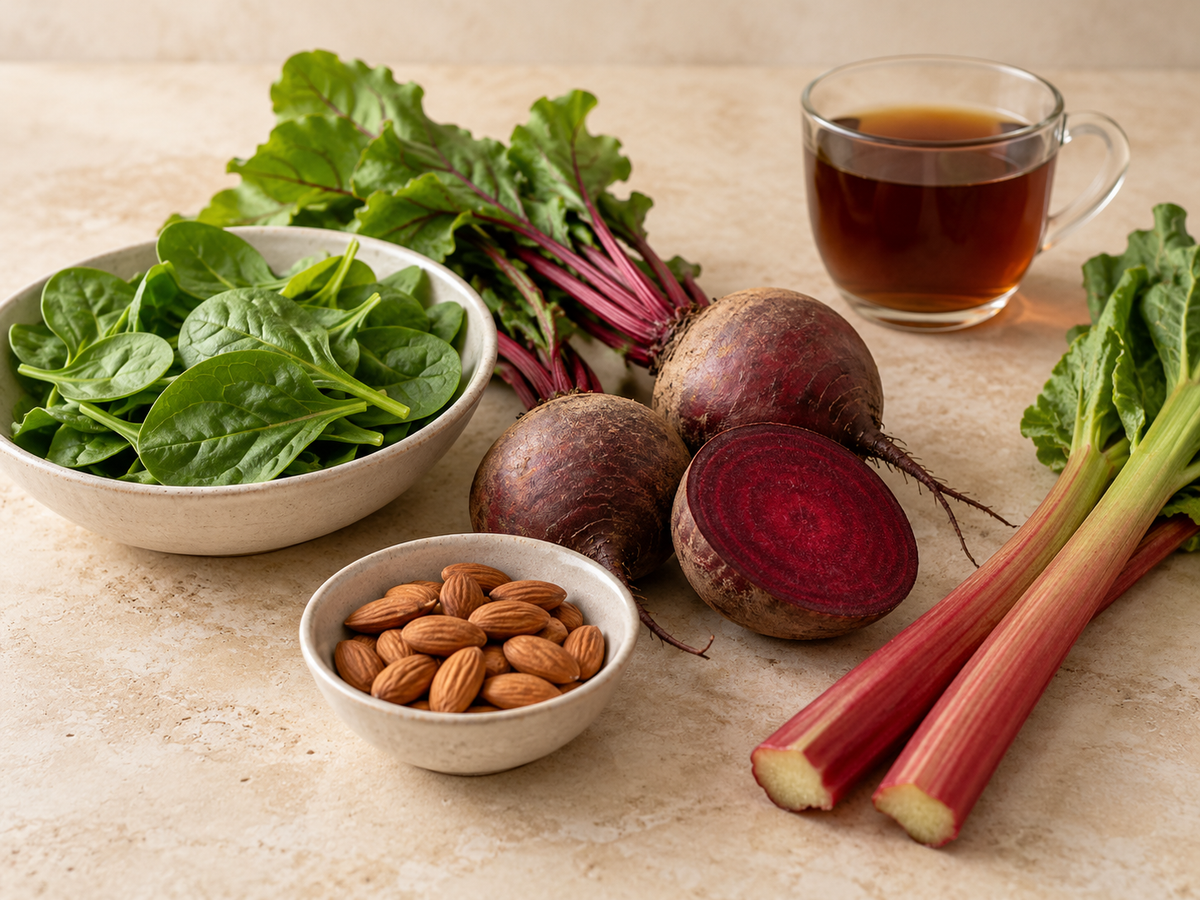
You have almost certainly eaten some today. Oxalates are in spinach, rhubarb, beets, almonds, and black tea. This is ordinary plant chemistry, not a contaminant or an additive.
Why the kidneys are the only exit:
-
 Oxalate binds to calcium, and your body has no way to break it down.
-
Anything absorbed into the bloodstream has to be filtered by the kidneys and excreted in urine. There is no other route out.
-
At normal dietary levels, that system handles it easily. The question is what happens when the load goes up tenfold and stays there for years.


When researchers analyzed the chaga powder behind a documented Korean case of kidney failure, it measured 14.2 grams of oxalate per 100 grams.
That is roughly 14% oxalate by weight, and about fifteen times the oxalate density of raw spinach.
Content varies, too. Chaga is wild, and as we cover in “What is Chaga?”, the conk draws its chemistry straight out of one particular birch in one particular forest. Published figures differ between samples. Almost nothing on the market is tested for oxalate at all, and if a label does not report a number, nobody measured one.
Why tea, powder, and capsules pass it straight to you
Oxalate is water-soluble.
That means it dissolves into your brew alongside everything you actually want.

Tea and decoctions
pull the beneficial compounds and the oxalate into the same cup.

Raw powder
delivers the entire load because nothing has been separated out.

Capsules
of ground conk do the same thing in a smaller package.
None of these methods separates the two. None of them were designed to. That is the problem we set out to solve, and solving it is the whole reason BOOM Chaga looks the way it does.

How BOOM Chaga removes oxalic acid
Everything above is the problem. Here is our answer to it.


BOOM Chaga vs. raw chaga, tea, powder & capsules
Swipe or scroll to compare →
| Comparison |

|
Tea or decoction | Powder | Capsules |
|---|---|---|---|---|
| Oxalate |
None detected
|
Dissolves into your drink | Full load consumed | Full load consumed |
| Oxalate tested? |
Third-party tested
|
No | Rarely | Rarely |
| Extraction |
Water only, both fractions
|
Water-soluble only | None, cell walls stay intact | Varies, often unextracted |
| Dose |
Single-serve, consistent
|
Unknown, varies by brew | Approximate | Stated, potency varies |
| Contaminant testing |
Third-party tested
|
Depends on supplier | Varies | Varies |
| Prep time |
Two seconds
|
2 to 8 hours | Stir and hope | None |

The oxalate issue is a preparation problem, not a problem with the chaga itself.
Everything that makes chaga worth drinking is still true. The antioxidant density is genuinely exceptional. Beta-glucans are at the center of serious immune research. People across the northern forest belt called it the King of Herbs and drank it daily for centuries, and they were not wrong to.
None of that changes because of anything on this page. What changes is what you should expect from the product you buy

Whatever chaga you choose, these habits keep the oxalate question small. With BOOM Chaga, the first two are already handled.
-
Stick to one serving a day. More is not better here, and dose is half of what went wrong in every documented case.
-
Choose an extract over raw powder for long-term daily use. All three cases involved powder.
-
Drink plenty of water. Good practice regardless, and it costs you nothing.
-
Watch high-dose vitamin C alongside high-oxalate foods. Your body turns part of it into more oxalate.
-
Talk to your doctor first if you have kidney disease or have ever passed a stone.
Disclaimer: These statements have not been evaluated by the Food and Drug Administration. BOOM Chaga is not intended to diagnose, treat, cure, or prevent any disease. Individual results may vary. Consult your healthcare provider before adding any functional beverage to your routine, especially if you are pregnant, nursing, taking medication, or managing a kidney or other health condition.
FAQ
Is chaga bad for your kidneys?
Chaga is not inherently bad for your kidneys, but it is extremely high in oxalate. Three published cases have linked heavy, sustained use of raw chaga powder to kidney injury. Every documented case involved high daily doses over months or years, not a normal serving. If you have kidney disease or a history of stones, talk to your doctor before taking chaga in any form.
Does chaga cause kidney problems?
Chaga does not cause kidney problems for most healthy adults at normal servings, but at high doses over long periods, it can. The documented chaga side effects involving the kidneys all trace back to a single cause, oxalate, and all follow the same pattern of raw powder taken in large amounts for months or years. Dose and duration are the variables that matter.
What is chaga oxalate nephropathy?
Chaga oxalate nephropathy is a kidney injury caused by calcium oxalate crystals building up in kidney tissue after heavy chaga consumption. It is the mechanism behind every documented case of chaga kidney damage. It was first reported in 2014, with two further cases published in 2020 and 2022. It is a recognized form of secondary oxalate nephropathy, the same condition documented after bariatric surgery and high-dose vitamin C.
How much oxalate is in chaga?
Chaga is one of the highest-oxalate foods known. A powder analyzed in a 2020 Korean case report contained 14.2 grams of oxalate per 100 grams, roughly fifteen times the oxalate density of raw spinach. Content varies between wild samples, and most chaga products are never tested for it.
Can chaga cause kidney stones?
Chaga may plausibly contribute to kidney stone risk, as roughly 8 in 10 stones are composed of calcium oxalate, and chaga is exceptionally oxalate-dense. No published case has specifically attributed a stone to chaga, but the mechanism is the same as that behind standard advice to watch high-oxalate foods if you are a stone former. Staying well hydrated and eating calcium with meals both help.
Is chaga safe if I have had kidney stones?
If you have had a kidney stone, ask your doctor before taking chaga. A previous calcium oxalate stone means your body has already shown a tendency to crystallize oxalate, which makes a very high-oxalate ingredient worth a professional opinion. That is not a call we can make for you, no matter the product.
Does brewing or boiling chaga remove the oxalates?
No, and boiling works against you here. Oxalate is water-soluble, so simmering it pulls it directly into the tea alongside the compounds you want. With vegetables, you can boil and discard the water, but with chaga tea, the water is the product. Longer brewing means more of everything, oxalate included. You cannot brew your way to a low-oxalate chaga, let alone an oxalate-free chaga. That takes a separation step no home method can perform.
Is BOOM Chaga oxalate-free?
Yes. An independent third-party lab tests the finished product before release and finds no detectable oxalate. That is the whole reason the process exists, and it is why we are comfortable putting oxalate-free on the box. We have not found another chaga product that can say the same. We will share the certificate of analysis with anyone who asks for it.

First time here?
See “What is Chaga?” or the “Benefits of Chaga.”
Footnotes:
- Kikuchi Y, Seta K, Ogawa Y, et al. Chaga mushroom-induced oxalate nephropathy. Clinical Nephrology. 2014;81(6):440–444.
- Lumlertgul N, Siribamrungwong M, Jaber BL, Susantitaphong P. Secondary oxalate nephropathy: a systematic review. Kidney International Reports. 2018;3(6):1363–1372.
- Lee S, Lee HY, Park Y, et al. Development of end stage renal disease after long-term ingestion of chaga mushroom: case report and review of literatures. Journal of Korean Medical Science. 2020;35(19):e122.
- Kwon YJ, Son HS, Lee SM, et al. Chaga mushroom-induced oxalate nephropathy that clinically manifested as nephrotic syndrome. Medicine. 2022;101(11):e28997.
- A brief overview of the medicinal and nutraceutical importance of Inonotus obliquus (chaga) mushrooms. Heliyon. 2024.

