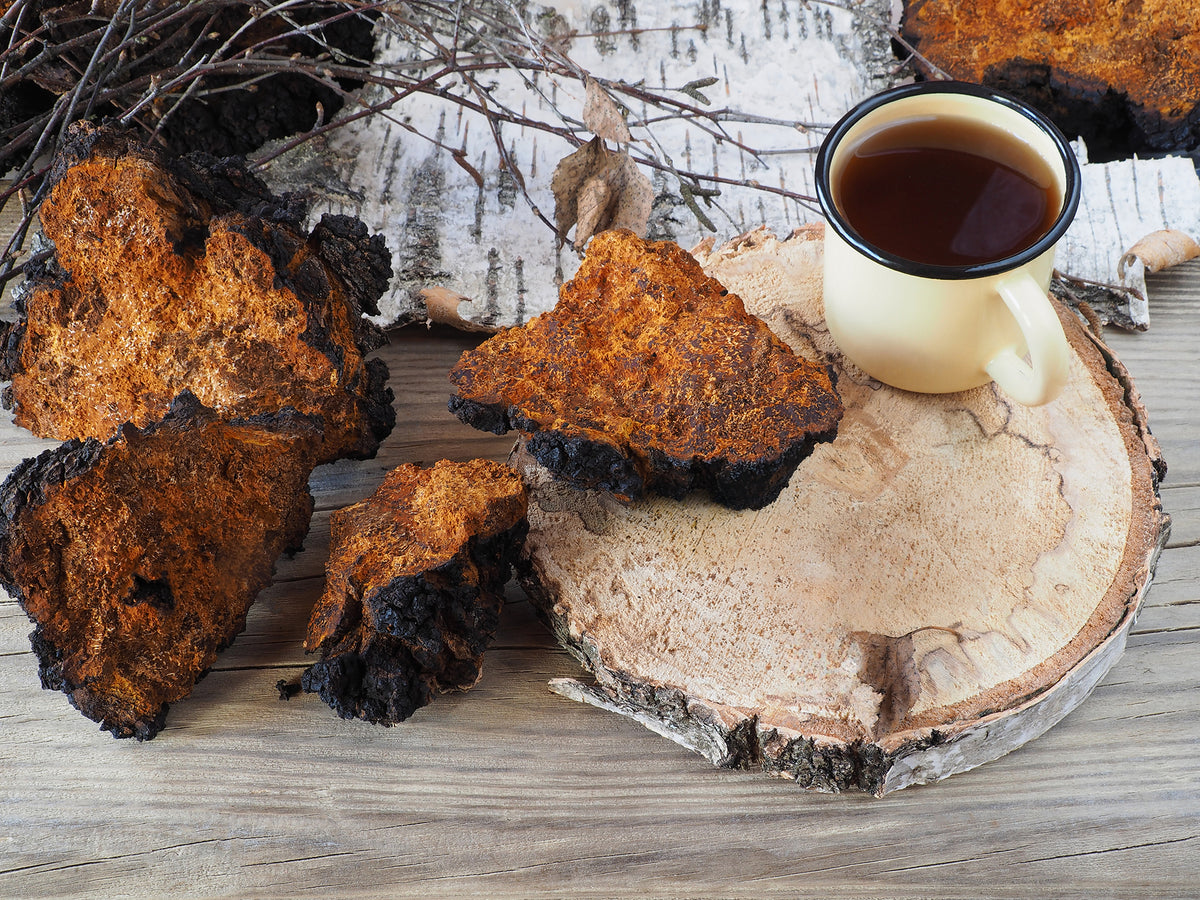
Chaga (Inonotus obliquus) is a fungus that grows on birch trees in the cold forests of the Northern Hemisphere. It does not look like a traditional mushroom. It looks like a lump of burnt charcoal stuck to the side of a trunk — cracked, black, and hard as a rock. Split one open, though, and the inside is a beautiful rusty orange.
That strange black mass is what people have been harvesting and brewing for centuries.
It also contains something most chaga brands would rather not talk about. Chaga is one of the highest-oxalate foods known, and that matters if you plan to drink it every day.
Here is everything you need to know about what chaga is, where it comes from, what’s in it, and how to take it safely.
What exactly is chaga?
Yes, chaga is a mushroom, and there is a fascinating detail underneath that almost nobody bothers to explain.
Chaga belongs to the Kingdom Fungi and sits squarely in the family of functional mushrooms alongside reishi, lion's mane, and cordyceps. When you drink chaga, you’re drinking a mushroom.
Compared to every other mushroom on the shelf, the black conk harvested off the birch is not a classic fruiting body, and it doesn’t have the umbrella shape most people associate with mushrooms. It is a sclerotium, a dense mass of fungal mycelium fused with wood from the host tree. Scientists also call it a sterile conk, as it produces no spores.
The classic fruiting body does exist; it forms as a thin layer beneath the bark, usually only after the host tree has died or fallen, and it lasts only briefly. Almost nobody ever sees one.
Since the sclerotium is where the compounds live, it’s the part everyone wants. Decades of slow growth inside a living birch is exactly what concentrates the melanin, antioxidants, and betulin that chaga draws straight out of the tree. The part people have prized for centuries grows in that unusual form.
The word arrived in English through Russian, spelled чага and pronounced chah-ga. Russian borrowed it from Komi, a Finno-Ugric language spoken around the Ural Mountains, where the word means a fungus growing on a tree and, in everyday use, simply means ‘mushroom.’
The chaga mushroom meaning is a happy little redundancy. The name already says mushroom, and those who lived alongside it for centuries never had any doubt about what it was.
The nickname shows up in a few forms: King of Herbs. King of Mushrooms. King of Superfoods.
They all come from Siberian and East Asian tradition, where chaga sat at the very top of the tonic hierarchy. It is honorific, a reflection of how highly people regarded it, not a scientific ranking. The name stuck because it’s a great name, and because chaga's antioxidant density gives it something real to stand on.
What’s inside chaga?
Chaga's reputation rests on a handful of compound families. Here is what’s actually in there.
What forms does chaga come in?
Chaga comes in several forms, and they are not equal:
Source matters as much as form. Products made from lab-grown mycelium on grain carry the grain's starch along with them and do not match the compound profile of a wild-harvested conk.
There are a few extraction approaches, and they pull out different things:
Swipe or scroll to compare →
| Approach | What it captures | What it misses |
|---|---|---|
| Home simmer, hot water at normal pressure | Beta-glucans, polysaccharides, melanin, water-soluble antioxidants | Triterpenoids and betulinic acid, and the oxalates come along for the ride |
| Alcohol or glycerine tincture | Triterpenoids, betulinic acid, betulin | Most polysaccharides, plus residual solvent, off-taste, and oxalates left unaddressed |
| Water extraction under heat and pressure | Both fractions, with no residual solvent | Requires equipment and process control no home brew can replicate |
What does that mean for you?
- Brewing at home is cheap, traditional, and it works for the water-soluble fraction. It is also slow, it will not reach the triterpenoids at stovetop temperature, you have no idea what dose you are getting, and it does nothing about oxalates.
- A pre-extracted liquid is consistent, instant, and the dose is known. The catch is that quality depends entirely on who made it, what their starting chaga is (lab-grown, molded, right particle size, etc.), and how effectively they process and store it, which is why testing and transparency matter so much.
Is chaga safe?
For most healthy adults, chaga is well-tolerated. Plenty of people have taken it daily for years with no trouble at all, and side effects in the general population are uncommon and mild. As with all natural supplements, consult your primary physician if there are any concerns.
Chaga has not been studied extensively for drug interactions, but a few are worth flagging. Chaga may affect platelet aggregation, so it could enhance the effects of blood thinners such as warfarin, clopidogrel, or aspirin. Animal research also suggests it may lower blood sugar, which matters if you take insulin or oral diabetes medication. Either way, talk to your prescriber before you start.
Chaga is also studied for immune-modulating activity, so check with a physician if you are on immunosuppressant therapy.

Get medical clearance first, if you are:
-
Pregnant or nursing
-
Living with kidney disease or a history of kidney stones
-
Taking blood thinners or antiplatelet medication
-
Managing diabetes with medication
-
Scheduled for surgery in the next two weeks
-
On immunosuppressant therapy
-
Allergic to fungi, birch or molds
FAQ
Is chaga a mushroom or a fungus?
Chaga is both a mushroom and a fungus. It’s a functional mushroom in the same category as reishi, lion's mane, and cordyceps. What makes it unusual is its shape. The harvested part, that black conk on the birch, is a sclerotium, a dense mass of mycelium and host wood, rather than the umbrella-shaped fruiting body people picture.
What does chaga taste like?
Chaga tastes mild and earthy, with a little natural sweetness and a touch of bitterness. A lot of people pick up vanilla or light coffee notes. It is much easier to drink than reishi, and it blends into coffee, tea, or a smoothie without taking over.
What is chaga good for?
Chaga is used as an antioxidant-rich daily drink. That is how people took it across Siberia and Northern Europe for centuries, and it is still the main way people use it today. Laboratory analysis of the raw conk shows high concentrations of polyphenols, melanin, and SOD, along with beta-glucans and triterpenoids. What those lab numbers mean once you drink it is a separate question, and human clinical research is still limited, so think of chaga as a supportive daily habit rather than a treatment for any specific condition.
How is chaga different from reishi or lion’s mane?
Chaga is different from reishi and lion's mane in both its form and its compound profile. All three are functional fungi, but they are genuinely different organisms. Chaga is a sterile conk that grows on birch; it is very high in antioxidants and melanin, and it tastes mild. Reishi (Ganoderma lucidum) is a true woody fruiting body, distinctly bitter, and traditionally associated with calm and rest. Lion's mane (Hericium erinaceus) is the white shaggy one associated with cognitive support and the only one of three that people commonly eat.
Can you take chaga every day?
Yes, taking chaga every day is the traditional way. Because of the oxalate content, stick to the recommended serving size instead of piling it on; use an extract rather than raw powder for long-term daily use; drink plenty of water; and talk to your doctor if you have any kidney concerns.
Is chaga caffeine-free?
Yes, chaga is completely caffeine-free. The dark color and coffee-like character come from melanin and roasted, earthy compounds, not from stimulants. That is why chaga has historically worked as a coffee substitute and why it’s just as good in an evening cup as a morning one.